Five Countries, One Kitchen: Notes from the South Asia Foundational Learning Convening
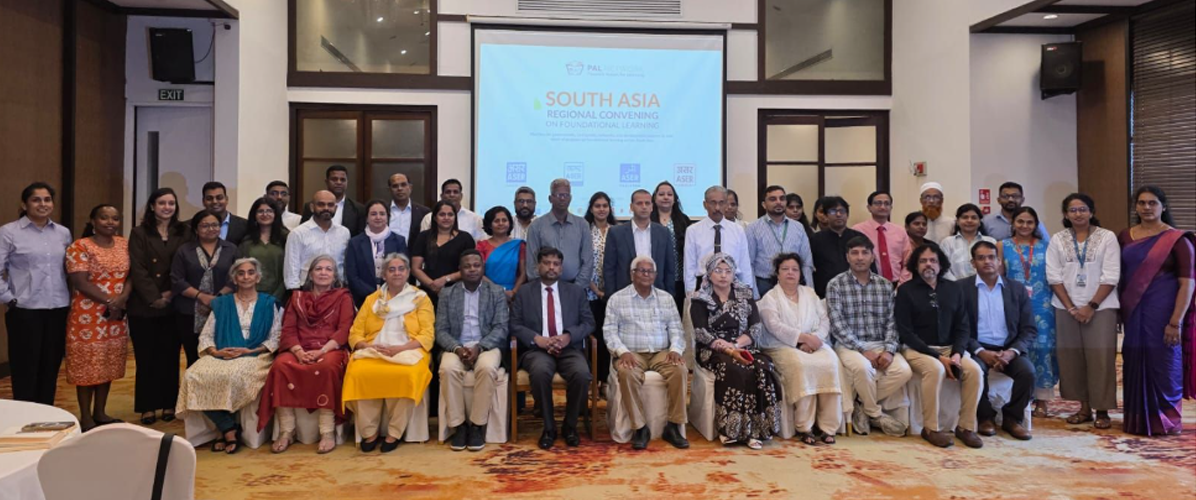
On 5 and 6 August 2026, delegations from Bangladesh, India, Nepal, Pakistan and Sri Lanka sat in the same room in Negombo, Sri Lanka for two days to talk about something that sounds simple and isn’t: how do you actually know whether a child can read? Every country in the room measures that differently, for different reasons, and hands the results to different people. The South Asia Regional Convening on Foundational Learning didn’t try to paper over that. It spent two days sitting inside the tangle instead.
That was more or less the argument running over both days: citizen-led assessments and common assessments aren’t competing for the same job. Citizen-led assessments, the community-administered surveys PAL Network grew out of, are good at telling a district or a village on what’s actually happening on the ground, including for children who aren’t in school at all. Common assessments like ICAN-ICAR exist to do something those tools were never built for: put numbers from Dhaka, Kathmandu and Islamabad on the same scale, and report them against SDG 4.1.1(a).
The Collaborative on Citizen Data post endorsement of the Copenhagen Framework at the UNSC March 2025 enshrines Citizen-led Assessments (CLA) as a legitimate way of strengthening data regimes and filling critical gaps in official statistics. Through the rigorous work that PAL Network has done with its member countries, this regional convening served as a platform to discuss the figures. The regional number is worth pausing on. Across Bangladesh, Nepal and Pakistan alone, the 2025 ICAN–ICAR cycle reached more than 15,000 households and over 20,000 children, generating evidence on foundational numeracy and reading that can be compared across borders in The State of Foundational Learning in the Global South 2025 report. Most national assessments are built to answer questions about one country’s own system. This one was built to let three systems talk to each other.
Pakistan came with a specific story, and it wasn’t really about numbers. Ms. Salma Naseer, serving as the Ministry of Federal Education and Professional Development (MoFE&PT) Pakistan’s technical focal person at the convening, used the country’s panel slot on 5 August to walk through how schools under the Federal Directorate of Education (FDE) have tried to make foundational learning implementation somebody’s actual job, not a policy sitting in a drawer. Every academic session opens with an FLN implementation plan at the FDE level, and each school builds a team around it: a coordinator, a co-coordinator, a literacy expert, a numeracy expert, all drawn from the school’s own teaching staff. It’s a small structural choice, but it solves a problem a lot of foundational learning programmes never quite crack. It puts quality assurance inside the school instead of treating the school as a delivery site for someone else’s programme.
The panel also pushed on a question that comes up wherever curriculum reform is being discussed: do teachers actually get a say in what they’re asked to teach? Pakistan’s answer, that classroom experience feeds directly into curriculum review rather than only its delivery, landed well with the room. In a region where curriculum change is so often handed down rather than built up, that distinction mattered to the people listening.
Pakistan also used the floor for things that don’t usually come up in an assessment conversation: legislation banning corporal punishment, safeguarding measures for students, and social-emotional learning now sitting inside the National Curriculum as a cross-cutting theme, with the Ministry of Federal Education and Professional Training developing digital content to support it. None of it was delivered as a highlight reel. It read more like people comparing notes on the same difficult job in different buildings.
Armando Ali, CEO PAL Network, asked to describe what PAL Network actually is, put it better than any strategy document could: “Think of a big village kitchen that cooks organic food produced in the village, using local spices and products grown from our own fields. We set up shared principles, invite others in, feed them, allow them to borrow our recipes, and learn from their recipes too.”
Rukmini Banerji, a pioneer in the field of Education in India and globally, who has spent more years than almost anyone figuring out how to find out whether a child can read, told the room about village chiefs in India who, once they understood what the assessment was actually measuring, started asking to have their own children tested. That’s not a data point. It’s what it looks like when an assessment stops being something done to a community and becomes something the community asks for.
The convening didn’t end in a signed framework, and it wasn’t trying to. What it produced was closer to what Pakistan’s own delegation report called for afterward: a sharper sense that the task now isn’t running more assessments, it’s building the machinery that turns evidence into a lesson plan, a coaching visit, a budget line.
Five countries, one region, one stubborn shared problem. The kitchen’s still cooking.
Box 1: Note: International Common Assessment for Numeracy (ICAN) and International Common Assessment for Reading (ICAR) by the PAL Network covered 11 countries, 89,000+ children assessed in 9 languages mapped to SDG 4.1.1a. For ICAN-ICAR, the PAL Network Dashboard is now live – a powerful new platform that makes #foundationallearning data across the Global South more accessible, interactive, and actionable than ever before.
For years, citizen-led assessments have generated vital evidence on children’s learning. The evidence is available through a dynamic dashboard where researchers, policymakers, practitioners, journalists, and development partners can explore data, compare countries, identify trends, and uncover insights that drive better decisions. Because evidence only creates impact when people can easily access and use it.
The PAL Network Dashboard is now live. Explore the platform, discover the stories behind the data, and see how evidence can inform better education decisions across the Global South.
https://dashboard.palnetwork.org/
Read ICAN-ICAR Spotlight Series
📄 Read the South Asia Hub Country Highlights Brief: https://lnkd.in/eT-v45g6
