
The Overburdened Backpack: How Too Many Books Are Hindering Foundational Learning in Pakistan
By Muhammad Shakeel Ahmad
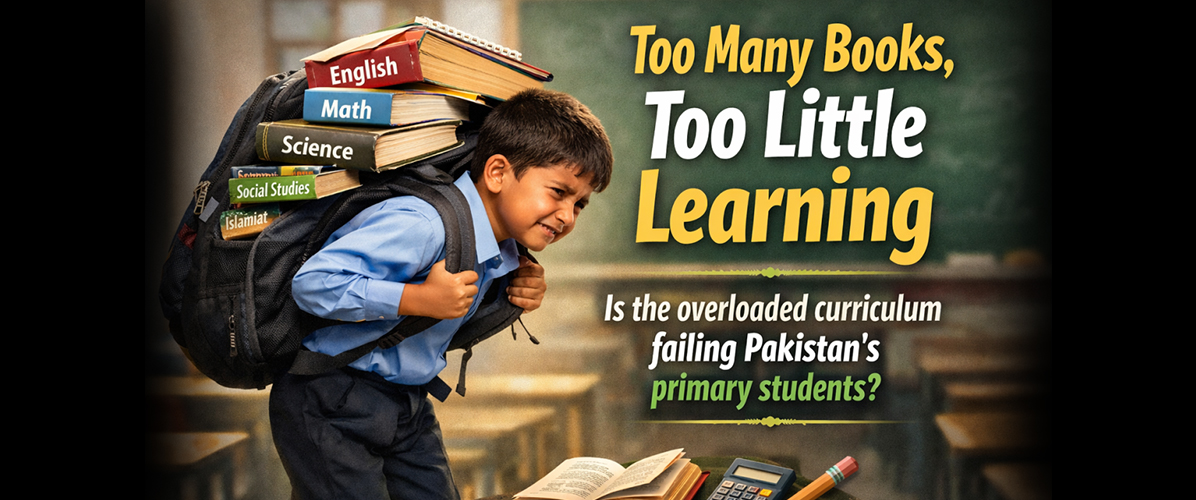
Foundational learning, defined as the ability of children to read with understanding and perform basic numeracy by the end of primary school, is the cornerstone of any effective education system. Without these essential skills, children struggle to benefit from further education and are at risk of falling permanently behind. In Pakistan, however, a critical yet often overlooked barrier to foundational learning lies within the classroom itself, the excessive number of textbooks prescribed at the primary level.
Across many public and private schools, primary grade students are required to study a wide range of subjects simultaneously. From early grades, children are often expected to engage with textbooks for English, Urdu, Mathematics, General Knowledge, Islamiat, Social Studies, Science, and additional workbooks or supplementary materials. For young learners who are still developing basic literacy and numeracy skills, this heavy academic load can be overwhelming. Instead of mastering essential reading and numeracy competencies, children are required to move quickly between subjects, often without developing a strong conceptual foundation.
Evidence from national learning assessments highlights the seriousness of the problem. The Annual Status of Education Report (ASER) Pakistan has consistently reported that a large proportion of primary grade children struggle with basic literacy and numeracy skills. According to ASER Pakistan 2023, nearly half of grade 5 students in rural areas are unable to read a simple grade 2 level sentence in Urdu, and many struggle with basic arithmetic such as division and subtraction (ASER Pakistan, 2023). These findings suggest that children are progressing through grades without mastering foundational skills.
One contributing factor is the fragmented curriculum structure where instructional time is divided across numerous subjects rather than prioritizing foundational competencies. Research on early grade learning suggests that young children learn best through focused practice, repetition, and guided instruction in core areas such as reading and mathematics (UNESCO, 2022). When teachers must cover several textbooks within limited classroom hours, teaching often becomes rushed and surface level, with greater emphasis on completing the syllabus rather than ensuring comprehension.
The cognitive burden placed on young learners also plays an important role. Educational psychology emphasizes that early grade students have limited cognitive processing capacity and benefit from structured and simplified learning experiences (Sweller, Ayres & Kalyuga, 2011). When children are exposed to multiple subjects simultaneously, particularly in languages they are still learning to read, their cognitive load increases significantly. This can lead to confusion, reduced comprehension, and reliance on rote memorization rather than meaningful learning.
International experience also highlights the importance of prioritizing foundational skills in the early years of schooling. The World Bank’s 2019 World Development Report on Learning emphasizes that education systems must ensure that children acquire basic literacy and numeracy early, otherwise later investments in education yield limited results (World Bank, 2019). Countries that have successfully improved learning outcomes often simplify the early grade curriculum and focus heavily on reading and mathematics in the first years of schooling.
Pakistan could benefit from adopting a similar approach. Simplifying the primary curriculum by reducing the number of textbooks in early grades could significantly improve learning outcomes. A focused curriculum centered on language development, reading comprehension, and basic mathematics would allow teachers to dedicate more time to practice, guided instruction, and individualized support for struggling learners.
In addition, integrated learning approaches could replace multiple standalone textbooks. Concepts from science, social studies, and general knowledge can be embedded within reading materials rather than taught as separate subjects during the early grades. Such integration not only reduces the academic burden on young learners but also makes learning more engaging and connected to real life experiences.
Education reforms in Pakistan often focus on teacher training, infrastructure, or technology. While these interventions are important, curriculum design and the number of textbooks assigned to young learners deserve equal attention. Reducing the academic load at the primary level is not about lowering standards, it is about ensuring that children truly master the most critical skills that determine their future learning trajectory.
If Pakistan is serious about improving foundational learning outcomes, policymakers must reconsider what and how much we expect children to learn in the early years of schooling. Sometimes improving education does not require adding more subjects or materials, it requires simplifying the system so that children can focus on what matters most, learning to read, understand, and think
References
- ASER Pakistan. (2023). Annual Status of Education Report (Rural) 2023. Lahore: Idara-e-Taleem-o-Aagahi.
- Sweller, J., Ayres, P., & Kalyuga, S. (2011). Cognitive Load Theory. Springer.
- UNESCO. (2022). Foundational Learning for All: Transforming Education Systems to Deliver on the SDG4 Promise. Paris: UNESCO.
- World Bank. (2019). World Development Report 2019: Learning to Realize Education’s Promise. Washington DC: World Bank.
